The Knitting Book

The Knitting Book
Author and consultant of these titles. Reviews: "When I saw The Knitting Book... I knew I had found the book I needed." "The Knitting Book” is one of those reference books you get when you’re serious about knitting"

Sunday, 4 September 2016

Cutting fabric strips for research garment


I have just spent ages cutting nylon tulle into 1/2 inch strips. I tried tearing them, but the edges roll and become too smooth for my purpose.
Luckily I could use a powered rotary cutter, but even so the tulle fought back and slithered around. 


The strips are to be woven into machine knit fabric to create a scratchy surface. Yes normally one is striving for a soft surface, but this garment is going to emulate for the wearer the feeling of having a skin disorder. 
Sampling so far has found that nylon tulle on a Lycra base knit can be quite irritating. When the nylon is slightly melted it becomes even more irritating. So that's the plan. 

Friday, 26 August 2016

Peg loom

Ross has built me a peg loom. This is the only photo so far but more will follow. We found helpful instructions on the Internet and the finished one has three rows of pegs of different sizes spaces differently. 
I want to make some rugs and although I am part way through hooking  one I also want to make a loosely woven fleece one to felt and I haveJacob's fleece that will do the job nicely. 

'plein air' knitting

Caravanning and knitting. Sitting in a field whilst dinner is cooking on the BBQ. Knitting baby boots for Katie's baby. 

Scotney castle walk

Just walked from Lamberhurst to Scotney Castle. No great distance but managed to get stung by nettles, thistles in my feet and a dash of sunburn. 
Rewarded by a very substantial cream tea with both fruit and cherry and coconut scones. 
Last quick visit to the toilets before walking back to the caravan.
This weather is what summer holidays should be for. 

Bought a Knitmaster 700 knitting machine

Yes there are lots of these at the University where I work, but this is my own. It needs a little TLC, and a new sponge bar, but otherwise a nice machine. I like these because they have a smooth action due to the rollers in the carriage. 
I am looking forward to setting it up and restoring it to its glory. 

Tuesday, 5 April 2016

Patwin Rug Wool Cutter has arrived

I bought this efficient little gadget on eBay last week, and it arrived today.  I have been cutting the wool manually with a gauge I made myself from 2 rectangles of heavy mount card stuck both sides a narrower rectangle of corrugated cardboard to allow for the scissors to be inserted to cut the wool. 

Here is how I made it.


And here is the dingy little Patwin Rug Wool Cutter with some of the shorter lengths.


Unfortunately the cutter cuts to a slghtly 
different length so I can't use it as is for the rug I have already started. But being inventive I hope I can pad the drum of the cutter so that it cuts to the same length as my gauge. 
The rug I am currently making is a latched rug hooked into a mesh background. The wool is a British wool and Alpaca mix, which I suspect will shed a lot, although the he British wool should make it reasonably hard wearing. I was seduced into buying the yarn as it was very attractive colours, an soft eggshell blue and a cream which will fit in with most colour schemes, and then a darker teal blue with a rust accent. The design is based on an African textile weave in simple graded stripes broken by a middle stripe with diamond and zip zag patterns as in my working graph.


Friday, 4 March 2016

A bit of kitchen and eco dyeing

This post is about a bit of experimenting I did last weekend. Dyeing is something I've mainly done with Dylon since leaving college myself. At college I learned to use acid and direct dyes in the correct chemicaly formulas, and I even went on a natural dyeing workshop many years ago but never seemed to have the time to put it into practise with small children around. I bought India Flint's inspiring
So last week, having visited the Ethel Mairet archive at Ditchling Museum and been entranced by the naturally dyed yarns, plus talking to my students about natural dyeing, (which fits in nicely with the hand knit and hand spinning I am teaching a the moment), a.bit of wet work seemed just right.
To start with I dug out some ecru and natural yarns - one is alpaca and merino, and the other two are merino, all double knit weight. Only small, odd balls to play with as this is just fun.
I was regretting the state of a bunch of gorgeous deep red roses given to me on Valentine's day by my lovely husband, which were dying, so I decided to use these to dye with. After a quite scoot around the internet I found these two helpful posts about dyeing with rose petals http://sadieraeandco.com/2013/03/12/rose-petal-dye/
and 
and got cracking.
First I chopped the heads up finely - this is to release the most colour potential.

...and then put them into about twice their volume of water and brought it to the boil and simmered for about an hour to an hour and a half.  Then I squeezed poured it all into a fine sieve and pressed out all the juice and water to extract this lovely coloured liquid (below). The petals were now a beige, having given up all their gorgeous red. I got very excited at this point and began to boil up pans of red onion skins, orange peel, carrot peelings, the cat... (oh no, sorry not the cat)...whatever I thought might give me a dye. Cooking spaghetti bolognese for dinner gave me a range of dye ingredients from the by-products! Luckily I am a good multi-tasker so I don't think any dye-stuff ended upon in the spag bol sauce, well no-one complained anyway...


Whilst the petals were simmering I had taken my yarns and wound them into hanks on a niddly-noddy - I would love a wooden one, but this rather ghastly plastic one works fine. Actually I think I might have a wooden one somewhere... must look through my cupboards.


Whilst hanking the yarns I inserted 'leases' at intevals around the hank (3 on this small hank). These prevent the yarn tangling during the dyeing process and make it easy to back wind into balls afterwards.


I do love the look of a hank twisted up tidily.


The hanks of yarn were then immersed in the vinegar mordant solution, (I used 3 parts water to 1 part vinegar). They were simmered in it for about an hour, and then left in a glass bowl until the liquid was cool. A plate on top kept them submerged.


 When they were ready, I took the hanks out of the mordant, drained them, and immersed the first one in the rose dye into which I had added a tsp of lemon juice as some people say this helps deepen the colour.


However, this is where I believe I went wrong. I had added salt when preparing it to help the dye stick, but I think I should have simmered the yarn in the dye at this stage, because the colour washed out even after an overnight soak. I did re-boil and simmer the next day but the lovely pink colour never returned, it went brownish. Not unattractive, but not the lovely pink it had promised after the first dyeing!


Not being put off I then dyed one hand in the orange peel bath and the other in the red onion skin one. I used only salt on the onion yarn. As with the rose version, I simmered it in a salt water solution and added salt to the dye bath as well and then simmered the yarn in that for an hour. The orange peel and carrot yarn was mordanted in vinegar as the rose yarn had been, salt was added to the dye bath and the yarn simmered in the dye for an  hour.
Above are the hanks hung up to dry after rinsing well,
and below are the final yarns


 I will knit these up once my cold has gone and I feel able to concentrate, and post the result...


Sunday, 21 February 2016

Review of The Knitting Book

Thank you 'butterfly reader' for your review of The Knitting Book:

'I do use other books as well as this one but this is the one I return to when I can't remember how to do something'

read the complete review at:
http://butterflyreader.blogspot.co.uk/2013/07/the-knitting-book-by-vikki-haffenden.html

Sequin yarn on a drop spindle

Its that time of year again when I become inspired afresh to spin when I freshen up my skills to teach basic principles and practise of spinning to the first year knit students. This year, I am concentrating on using drop spindles as the wheel can be quite intimidating as an introduction to spinning. Drop spindles are so accessible, and the look of pleasure on their faces when the first successful section of yarn is spun is so rewarding makes them the ideal introductory tool.

We start with tops so they don't have to card (time is short for the workshop), and I buy both tops and spindles from Wingham Wool Works http://www.winghamwoolwork.co.uk, and find the dyed Merino tops a really easy one for beginners as the long fibre is more forgiving of slipping fingers and fumbled drafting.
I have made a few quite successful drop spindles out of chop sticks and wooden toy wheels which work well for those who choose not to purchase their own spindle (although as these cost less than a round of drinks I try to persuade them to invest). I discovered the wheels weren't quite heavy enough, so have added a few pennies secured with BluTak as an interim measure - seems OK for the moment.
So whilst demonstrating I have spun a reasonable amount of purple tops up, and spent last evening plying this with a thread onto which I have threaded sequins - so have now got a pretty decorative yarn I will knit up and post here when done. Hopefully I have balanced the yarn sufficiently - but we will see. The fibre length for this was much shorter than merino so it is consequently a more woollen effect yarn.


Tuesday, 26 January 2016

Report on cross-breed sheep for higher quality wool and John Arbontextiles in North Devon

Devon Mule sheep cross bred Devon breed with Blue Faced Leincester produces softer but strong wool, used in this instance for walking socks.


Countryfile BBC1 Sunday 24th January 2016.
http://bobnational.net/record/357114
Or catch up on iPlayer 

Friday, 11 December 2015

How Zen is Your Knitting?

Do you enjoy knitting in a group? 

Mary Mussett and Dr Vikki Haffenden are very excited to be bringing these developmental Knitting Workshops to various venues in Brighton during 2016. In these workshops we will be combining our professional experience to provide you with the opportunity to enhance your skills in both mindfulness and the craft practice of knitting. 

More information to follow soon


Thursday, 5 November 2015

Correction to 'Felted Tote Bag' in The Knitting Book p 350-351.

Correction to 'Felted Tote Bag' in The Knitting Book p 350-351. Corrections in bold and italics. 

Pattern.
Cast on 50sts.
Starting with a k row, and working in st st, inc at both eds on 5th row. Work 10 rows without shaping. (52sts).
Row 16 (WS): Inc in first st. p15, cast off 20sts. p15 inc in last st. (54sts)
Carry on as pattern is printed.

Apologies - just have to remember that those wonderful pattern checkers are not infallible. It's all in the numbers...

Thursday, 15 October 2015

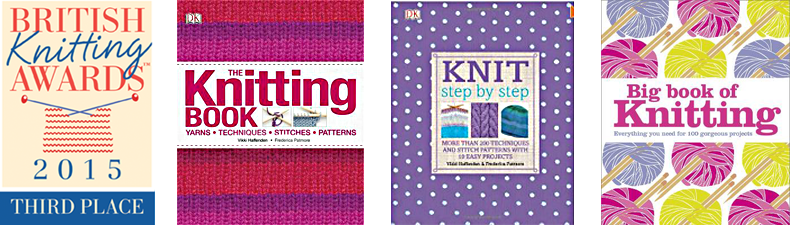
British Knitting Awards 2015

A big thanks to all of those who voted for The Knitting Book in the British Knitting Awards 2015.

'The Knitting Book is the book of all books for the knitter, whether you are a beginner or have been knitting for years...This book is so full of great information that it's an essential companion for every knitter.'
(Knitpicks.com )


The Knitting Book is available in Australia and the US, and has been translated into Dutch German and Croation.


Knit Step by Step
is also available in German and Portugese.


Patterns on Ravelry

My hand knit patterns from Rooster Book One are downloadable from Ravelry:

Man and Babies's Hat
http://www.ravelry.com/patterns/library/man-and-babiess-hat
 Soft Baby Blanket

http://www.ravelry.com/patterns/library/soft-baby-blanket-2

both patterns are worked in the lovely Rooster yarns.


Thursday, 1 October 2015

My Passap E6000 is out of the cupboard!

I have finally unearthed my Passap E6000 from its hibernation and even got the motor running!
Of course I still don't have much time to use it - but last night I stole a few hours to try to remember how to use it. Luckily I spent the summer servicing a 'green' Passap and bringing it back to life, its just the electronic patterning that I have lost touch with.
So here is my first piece off the machine that even warrants mentioning. Its a racked tuck pattern with a needle selection on the front bed, knitted with manual settings only as I didn't have the energy to tackle the controller at the time. Its knitted in 2/16nm lambswool and washed.


An award!

How exciting to have been awarded a place in the British Knitting Awards. Thank you to all who voted for my book. I will be going to the Knitting and Stitching Show at Olympia next week to receive my award.


Monday, 20 July 2015

France, food and cycling

We are coming to the end of a 2 week holiday in Brittany in our caravan. I have just eaten a delicious lemon tart.


Whilst eating it I have been busy though, knitting a thick lining for the tea cosy for when we take the caravan out in colder weather. We did that at Easter and there was ice in the fire-bucket, plus the gas heater broke so we used the oven to keep warm. But I am moving off the theme of food and France.
Food, always an enjoyable topic, has been fun this holiday. We have a Remoska cooker which we use when on mains electric which can be used to make tremendous meals. It does great jacket potatoes as well. Salads have featured large though as its been so warm.


Aubergine and Feta bake is tomorrow, but I have made bread, pizza, lasagne, birthday cakes,  bolognese sauce, loads of dishes in the Remoska. The slow cooker is also useful, great for bolognese, stews, curries that will cook whilst we are out during the day. I've not used that this holiday as its so warm, but it was great last summer when we were walking in the New Forest and Forest of Dean. 
We have been cycling along parts of the Nantes to Brest canal towpath - the Velodyssey, and it's been lovely. It's flat, which is ideal for the folding bikes we have with us, and cycling gives you time to see things and the opportunity to just get off and potter in villages and towns. 


The other thing I have managed this holiday is to thoroughly teach myself how to Tunisian crochet. Thanks to Michelle at poppyandbliss.com for her helpful advice and simple pattern to get me started. 


The yarn isn't very good for the stitch as its not got enough twist, so splits easily as you can see, plus of course I have brought a slightly small hook just to make my task more difficult. However, I have the basic technique now so will work on it further.

Monday, 4 May 2015

Illuminated Bernina 1030

I have replaced the LED strip lights my son originally fitted to the underside of the arm of my Bernina 1030 sewing machine. These had to come off when the machine blew it's circuit board and needed repairing. They lost their stickiness, and as the set-up had never been very satisfactory due to lots of wires I looked for a better design. This new configuration of lights in series came from a YouTube video tutorial here: http://youtu.be/7J91Z9rngE0. The tutorial is very clear and simple to understand. 

I bought LED light strips from Maplin (20cm length with 12 LEDs in all in multiples of 3 and which I cut up into 2x6 lengths). I chose the non-waterproof as these mould to the curve better than the plastic coated ones I have tried before. I will see if they catch on the cloth more or get damaged easily - the reasons I originally chose the plastic coated version. These cost £5, the little plug was from the original lights and had cost £1.20 and the wires were odds we had around. The transformer from the original lights was from an old telephone. 

My kind husband helped with the soldering having watched me having problems as the soldering iron would not melt the solder. It was only when we searched this up online that we realised the tip was likely corroded and a new one needed. After a trip to Maplin and £7.99 for new tips it was plain sailing.

It works a treat, and the minimal wires are all held tidily at the back with sticky-backed Velcro cable strips, plus the wire to the transformer is easily removable to allow the machine to fit into the solid plastic cover that comes with the Bernina 1030. The Velcro strips were £4.15 for 10, and although I considered using Sugru to make cable clips I decided to spend the money on these instead.


I bought the 4 original strip LEDs from eBay with the wires already soldered on. However this, and the fact that the seller had cut off the little copper terminals at the opposite end meant they had to be wired in parallel and 
rendered it impossible to now put them into series. Wiring them up and attaching them in parallel onto the machine looked messy as there was so much wire, and four strips was really overkill. 

Two strips seem more then adequate this time. I could of course buy some more and add another two to the existing two if I find it necessary, or even use one of the waterproof strips if I take off the old wiring. As you can see, even without its own two lights illuminated there is a much better field of light for working on black fabric and at night. 

Whilst installing the lights on the machine I managed to break one of the solder joints, but easily re-soldered it. 

So just to mention, when the machine blew up (hmmm, that was fun), white smoke and stink of melting plastic... I found a really helpful machine repair workshop in Portsmouth, Hampshire called Sueco who fixed and serviced the machine for what was a shocking figure; but far less than the cost of replacing a Bernina of this quality at today's prices. They were the only local company of the many I called who a) knew what the problem I was describing was likely to be b) confidently said they would be able to fix it and  c) could give me a rough estimate for the job. So thank-you Sueco! It now sews smoothly and quietly and, let's hope, for a long time to come.